
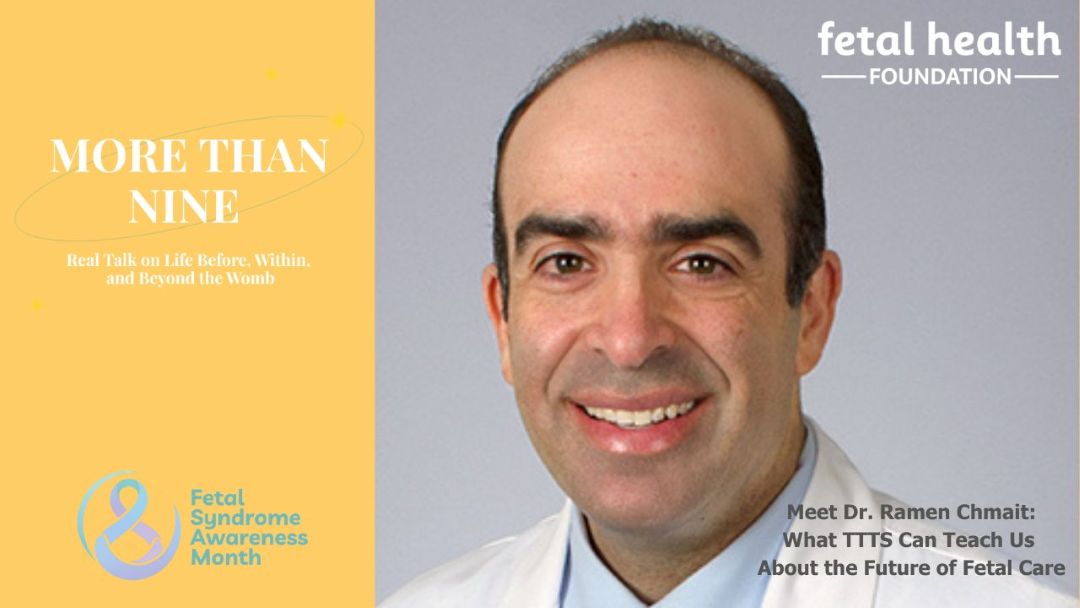
During Fetal Syndrome Awareness Month, we’re highlighting a TTTS story that shows just how far fetal medicine can come.
Twenty-three years ago, Lonnie and Michelle Somers faced a devastating diagnosis during Michelle’s pregnancy with their twin daughters, Ashley and Aspen. Their babies had Twin-to-Twin Transfusion Syndrome (TTTS), and the family was suddenly faced with decisions about a treatment that was still relatively new.
Dr. Ramen Chmait was part of the fetal surgery team that treated the twins. What began as a doctor-family relationship eventually became a lasting friendship.
The passage of time gives Lonnie and Dr. Chmait a unique perspective—not only on the experience that brought them together, but on how dramatically fetal medicine has evolved.
In a new episode of More Than Nine: Real Talk on Life Before, Within, and Beyond the Womb, they look back at those early days of fetal surgery, discuss the advances that have transformed TTTS care and explore what may be possible in the future of fetal therapy.
From an emerging field to established fetal therapy
When Lonnie and Michelle received their diagnosis, fetal surgery was still an emerging field. Treatment options were limited, and families often had to travel to specialized centers for care.
Today, fetoscopic laser photocoagulation is an established treatment for significant TTTS. During the minimally invasive procedure, a fetal surgeon uses a tiny camera to identify abnormal blood-vessel connections between the twins on the shared placenta and uses a laser to seal them. The goal is to separate the twins’ circulations and stop the unequal blood exchange that causes TTTS.
Outcomes have also improved significantly. A 2025 systematic review and meta-analysis of 26 studies found that, following laser treatment, at least one twin survived in approximately 89% of Stage I pregnancies, 87% of Stage II, 77% of Stage III and 80% of Stage IV pregnancies. Both twins survived in approximately 73%, 68%, 48% and 53% of pregnancies, respectively. Outcomes vary based on disease severity, gestational age, center experience and other factors. But these numbers illustrate how advances in fetal therapy have changed the outlook for families facing TTTS.
What 23 years can change
Lonnie and Michelle’s story offers something that statistics alone cannot: perspective.
The babies at the center of that frightening diagnosis are now grown. And the physician who helped care for them has spent the years since then watching fetal medicine evolve. TTTS care has advanced through better fetal imaging, greater understanding of placental blood flow, increasingly sophisticated surgical techniques and the growth of specialized fetal care centers. The field has also continued to refine laser treatment and improve the management of complications that can occur before and after fetal intervention.
For families receiving a TTTS diagnosis today, that progress matters. A diagnosis is still serious. But the options available to families—and what physicians understand about how to manage these pregnancies—are very different from what they were more than two decades ago.
What’s next?
Fetal medicine doesn’t stand still. Researchers and fetal specialists continue to work toward earlier and more precise diagnosis, better ways to identify which babies are most at risk, increasingly targeted interventions and improved long-term outcomes.
The goal isn’t simply to perform a successful procedure. It’s to give babies the best possible chance not only to survive, but to thrive. That is the promise of fetal therapy—and one of the reasons awareness matters.
From a fetal surgery to a friendship
There is something remarkable about Lonnie and Dr. Chmait’s relationship. Dr. Chmait first met Ashley and Aspen before they were born, when he was part of the team helping Lonnie and Michelle through an unimaginable time. What began in a hospital setting grew into a lasting friendship.
Today, they look back on that experience from two very different perspectives: Lonnie as a father whose daughters are now grown, and Dr. Chmait as a physician who has spent his career witnessing—and helping advance—the evolution of fetal therapy.
For Lonnie and Michelle, their experience with TTTS ultimately became much bigger than their own family. It inspired them to create the Fetal Health Foundation, with a mission to help other families facing fetal diagnoses find information, support and specialized care. More than two decades later, their story remains a powerful reminder of what progress in fetal medicine can mean for families.
Behind every diagnosis is a family. And behind every advance in fetal medicine is the potential to change that family’s story.
Listen to the episode
In this special More Than Nine episode, Lonnie Somers and Dr. Ramen Chmait revisit the experience that brought them together, talk about how their friendship developed, and explore how TTTS care has evolved.
They also look ahead to the future of fetal surgery and what may be possible for families facing fetal diagnoses in the years to come.
🎙️ Listen to More Than Nine during Fetal Syndrome Awareness Month.
Fetal Health Foundation’s Commitment
Fetal Health Foundation is dedicated to ensuring that no family faces a prenatal diagnosis alone.
As FHF celebrates 20 years of supporting families, we continue building on a legacy of education, connection, and advocacy to improve the experience of families navigating fetal diagnoses.
Throughout Fetal Syndrome Awareness Month — and every month — FHF works to:
- Provide trusted educational resources for families
- Connect families with experienced fetal care centers
- Increase awareness of fetal conditions and available care options
- Support research that advances diagnosis, treatment, and outcomes
- Foster collaboration among families, healthcare providers, researchers, and industry partners
 Twenty years of support. A future of hope. Together, we can increase awareness, inspire hope, and ensure that every family has access to the information and support they need throughout their journey.
Fetal Syndrome Awareness Month:
Every Diagnosis Deserves Awareness. Every Family Deserves Support.
Share this resource. Help families, healthcare providers, and communities find the information and support they need after a fetal diagnosis.
Your support makes this work possible. Consider making a donation to FHF.