
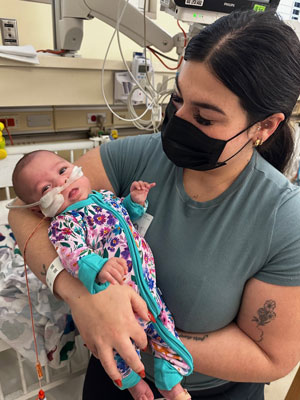
At Stanford Medicine Children’s Health, the CRIB Program supports some of the most medically fragile newborns — babies born extremely prematurely who require highly coordinated, long-term care in the NICU. Maya’s story begins here, at just 25 weeks gestation, when she entered the world far earlier than expected and immediately needed intensive medical support. From the very start, her care required constant attention, careful decision-making, and a team approach that adapted as her condition evolved.
Life beginning in the NICU
Maya’s earliest days were shaped by uncertainty and close monitoring, as her body worked to develop outside the womb far ahead of schedule. In the NICU, progress is never linear, and every improvement is met with new challenges that require careful balance. Her care team focused on stabilizing her most critical needs while supporting the gradual development of her organs and systems over time.
The CRIB Program approach
Within the CRIB Program, Maya’s care was guided by a coordinated team that brought together neonatology, cardiology, pulmonology, rehabilitation, and developmental specialists. Rather than working in isolation, these experts collaborated continuously, adjusting treatment plans in real time and aligning every decision around her changing needs. This integrated model allowed her care to evolve as one cohesive plan rather than multiple separate tracks.
A journey still unfolding
For Maya’s family, each day in the NICU brought both progress and unknowns, with milestones that mattered deeply and periods that required ongoing clinical interventions. The CRIB Program provided not only advanced medical care, but a consistent framework for navigating an unpredictable clinical course. To follow the full story of Maya’s experience and the care that supported her through more than a year in the NICU, read more here.